From Bletchley Park to a model you train in three minutes — and who is writing the rules in each case.
Warm-up · 8 minutes · journals only
Write instructions for finding a cat.
A computer will follow your steps exactly. It cannot see.
It cannot guess. It does not know what a cat is.
Five steps
Specific enough that a machine could run them. "Look for a cat" is not a step.
Then break it
Describe one cat photo your own instructions would get wrong.
What happened
Nobody has ever written those rules.
Every rule you wrote needs another rule underneath it.
Every rule you wrote has a photo that breaks it.
Face unlock, spam filters, autocomplete — none were built this way.
So how were they built?
Bletchley Park · 1939–45
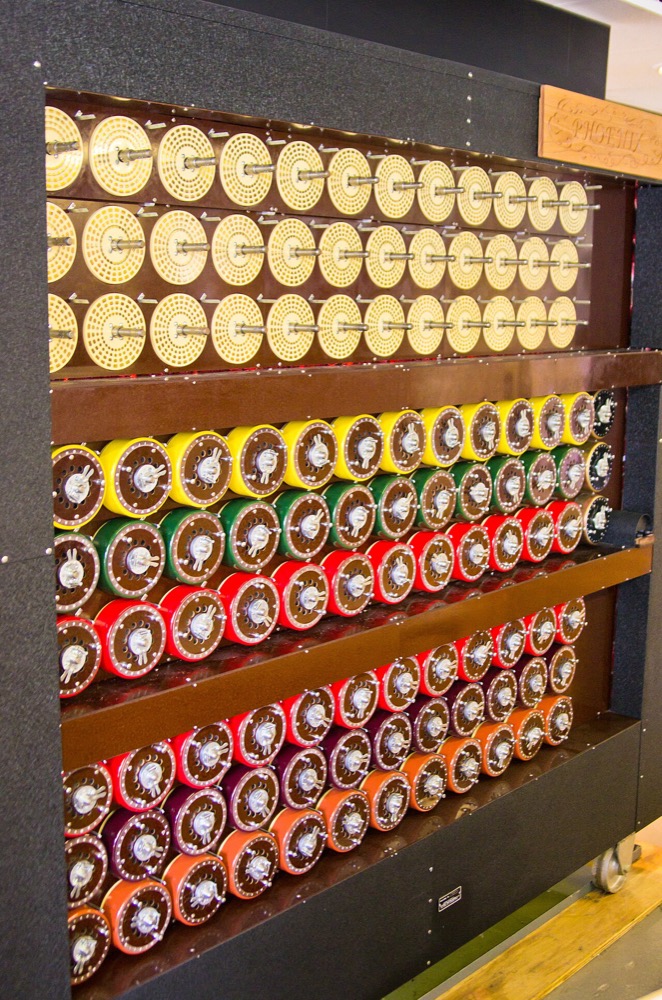
People wrote every rule.
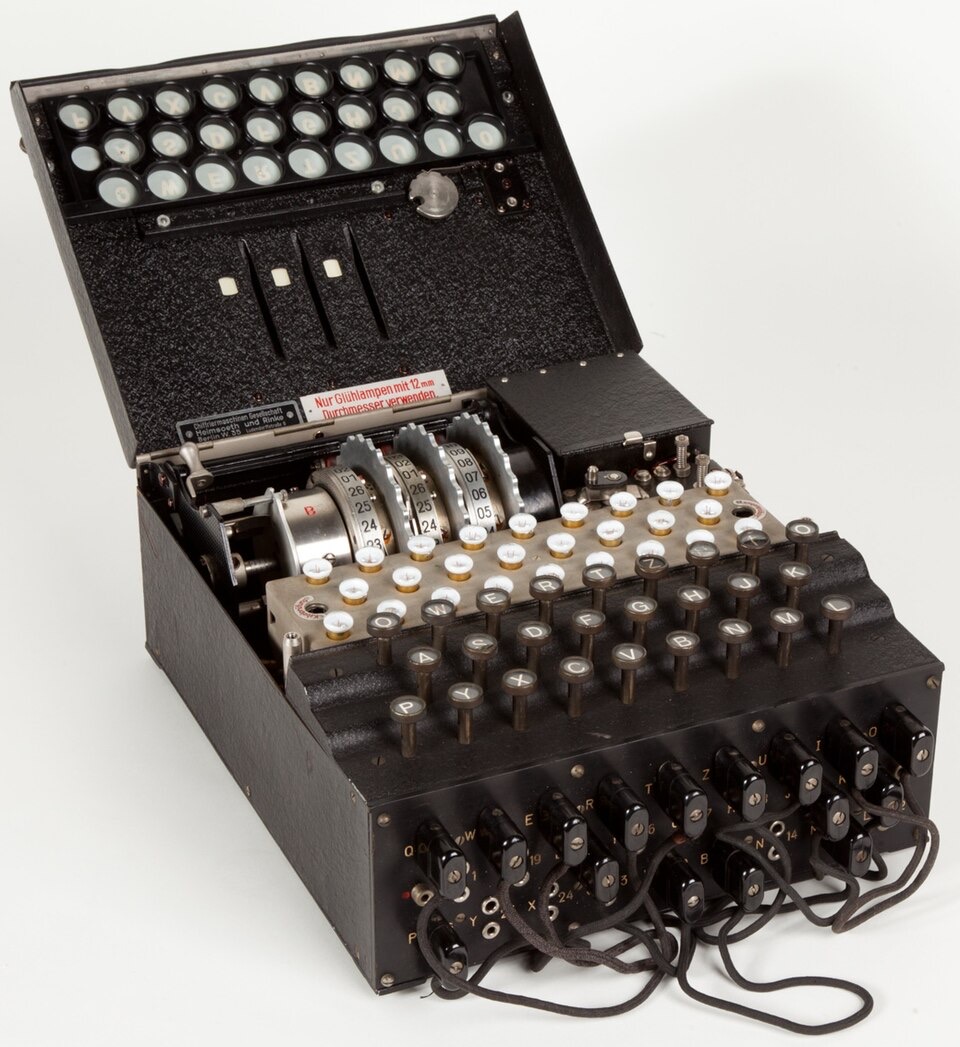
EnigmaThe German cipher machine. Its settings changed every day.
Alessandro Nassiri · CC BY-SA 4.0 · Wikimedia CommonsThe BombeBuilt to search Enigma settings. Every step it took was a rule a person worked out and wired in.
Antoine Taveneaux · CC BY-SA 3.0 · Wikimedia Commons
Why it worked: Enigma had rules. Hard ones,
but findable. Cats do not.
1950 · a different question
Can a machine think?
Turing suggested we stop asking what is going on inside a machine —
and judge it instead by how it behaves in a conversation.
Hold on to that. Someone is about to take
him up on it — and it will turn out that behaving convincingly in conversation
is much easier than it sounds.
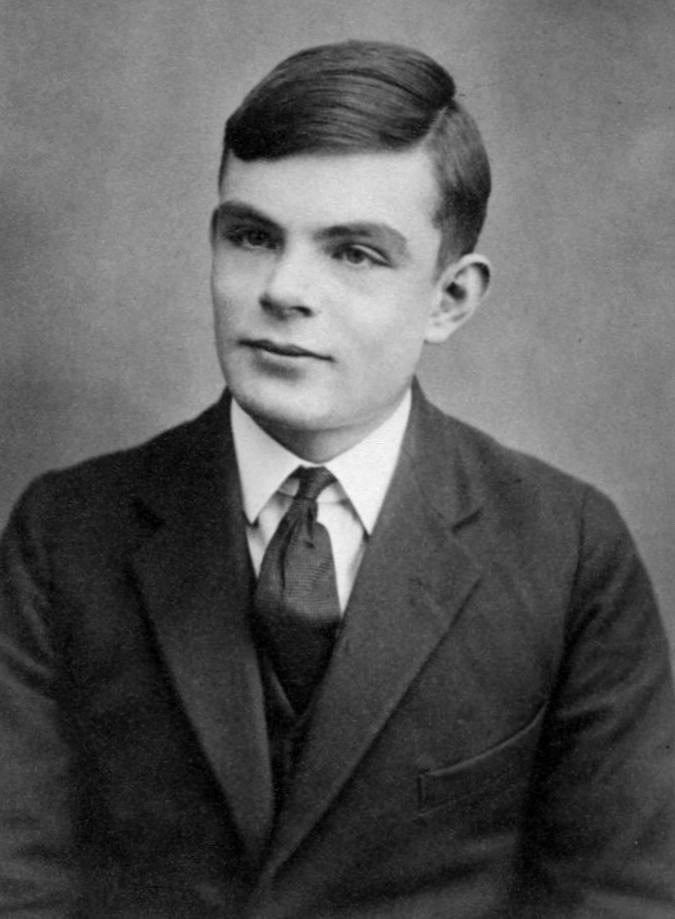
Alan Turing, aged 16Died 1954, aged 41, after being prosecuted for being gay.
Public domain · Wikimedia Commons
1966 · taking Turing up on it
ELIZA
A program with no learning and no training data —
rules all the way down — that people confided in anyway.
Person
My boyfriend made me come here.
ELIZA
Your boyfriend made you come here?
Say this out loud. Feeling understood is evidence about you,
not about the program. A modern chatbot is better at this than ELIZA — more convincing,
not more trustworthy. Neither is a therapist, a confidant, or a friend.
The answer to the cat question
Nobody writes the rules.
You could not write rules for "cat." So don't. Show a machine
examples instead.
Train it
Two objects we pick together. About thirty examples of each. Train. Test.
You never write a single rule.
Then hold one back
Choose a third object it has never seen.
Do not train it on this one.
Predict, then test
What will it say about the third object?
Write this down first
Which label will it choose?
How confident, roughly?
What would surprise you?
Then we show it
Whatever happens is the result — including if it hedges, or splits down the
middle. An unexpected outcome is not a failed experiment.
If it does answer confidently about something it has never seen —
why? Collect competing explanations before you pick one, and say which ones today's
test cannot tell apart.
Three machines, two kinds
Two ways to build
Rules a person wrote
The Bombe · ELIZA
A person specifies every step
You can read it afterward
Odd input → it breaks, or stalls
Rules fitted from examples
Teachable Machine
You supply examples, not steps
Mostly you cannot read it
Odd input → confident nonsense
That last row is the difference that matters all semester.
Class conventions · all semester
How we will work
1
Log the exact thing.
Prompt and output verbatim. A retyped output is not evidence.
2
Observation before interpretation.
"One sentence was false" ≠ "it lied." Say which you mean.
3
One variable at a time.
Two changes at once tells you nothing about either.
4
Name the authorship.
What you decided, what it produced. Every time.
5
Consent and privacy.
No real names, faces, or private details into any tool. Ever.
6
Participation is not obligation.
Observing, recording, questioning, declining — all full participation.
Reflection · 12 minutes · before you leave
One bounded claim
Writing explicit rules for "cat" felt…easyhardimpossible
Teachable Machine got the third object…rightwrongit hedged
The Bombe and ELIZA are alike in that…both learnedboth ran rules a person wroteboth understood
I observed
My evidence is
This suggests
but it does not establish
The fourth clause is the whole point. Anyone can make a claim. Naming its limit is what makes it honest.
Submit before you go
Classroom — transfer, attach, turn in
What
A photo of your own paper — your cat rules, your prediction, and your claim. Handout optional.
Named how
Lastname-U1D1
Also answer, in one line: name one decision you made today that a machine could not have made for you.
Thinking: copy your circled answers and your claim into the Classroom response box. Evidence: attach your cat rules, your written prediction for the held-out object, and your claim. Open the attachment to check it is readable, then turn in.
Next time
Breaking ELIZA
You met it today. Next time you take it apart.
Nobody will tell you its rules. You will work them out from the
replies — and then design an input that makes it fail.
The question underneath: if rules can look this much like
understanding, what would actually count as evidence that something understands?
Image credits
Wikimedia Commons
Enigma machine — Alessandro Nassiri, CC BY-SA 4.0
Turing–Welchman Bombe (rebuild) — Antoine Taveneaux, CC BY-SA 3.0
Alan Turing, aged 16 — public domain
Resized and recompressed; otherwise unmodified.
Full details in img/CREDITS.md.
This deck is built for a projector.Slides are a fixed 1920×1080 canvas, so text is tiny on a phone. Open it on a laptop or the classroom display. The worksheet reads fine on a phone.